
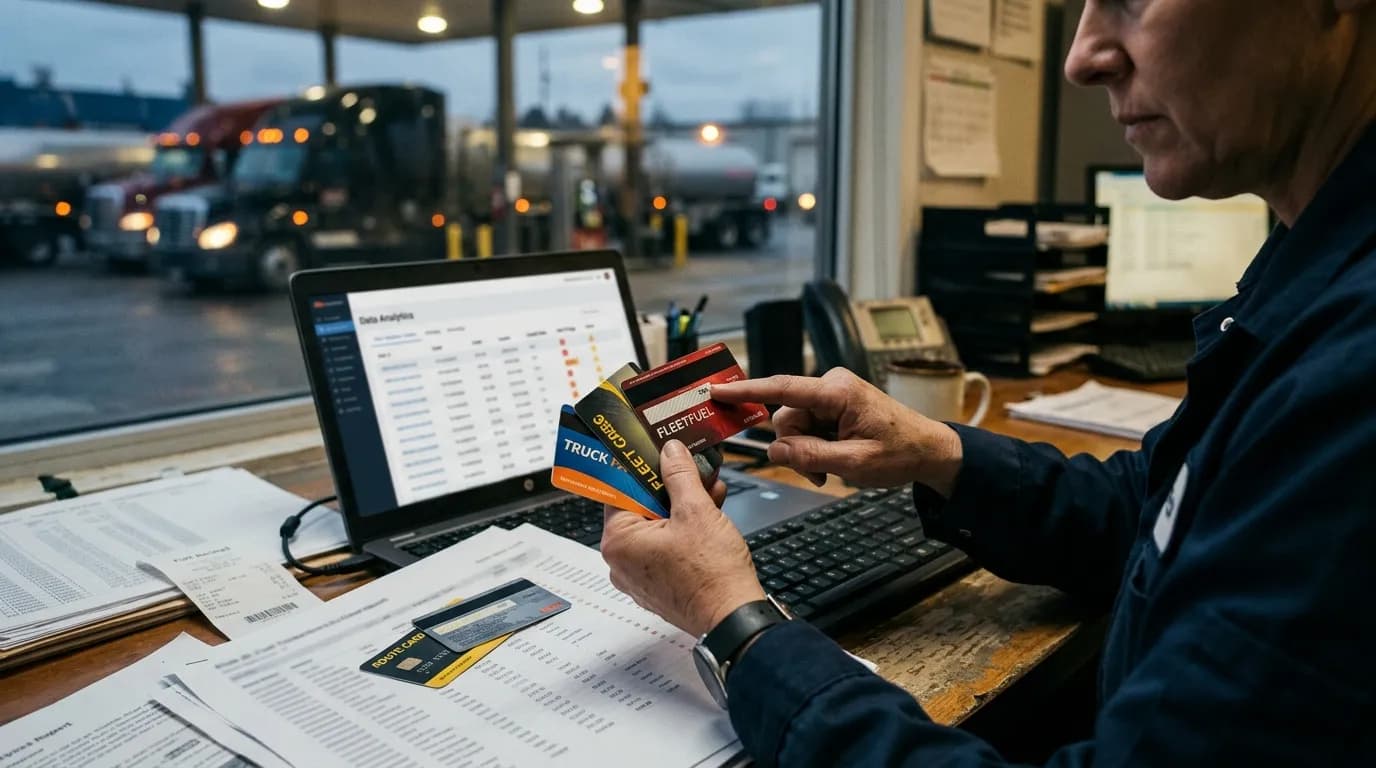
Fuel Card Fraud Is More Common Than You Think
Fuel cards are essential for fleet operations. They simplify fuel purchasing, provide detailed transaction data, and eliminate the need for drivers to use personal funds. But they also create an opportunity for fraud that many fleet operators underestimate.
Industry estimates suggest that 3-5% of fleet fuel spending is lost to fraud, misuse, or waste. For a fleet spending $15,000 per month on fuel, that is $450-$750 per month — or $5,400-$9,000 per year — walking out the door.
Understanding the types of fuel card fraud, recognizing the warning signs, and implementing prevention controls can save you thousands annually.
Common Types of Fuel Card Fraud
1. Personal Vehicle Fueling
The most common form of fuel card misuse. A driver uses the fleet fuel card to fill their personal vehicle before or after their shift. This is easy to do and hard to detect without proper controls.
2. Fuel Purchases for Third Parties
A driver fills up a friend's or family member's vehicle using the fleet card. This may happen at the pump (one transaction, two vehicles) or as a separate transaction.
3. Non-Fuel Purchases
Many fuel cards allow non-fuel purchases at gas stations — snacks, drinks, cigarettes, car washes, and even gift cards. Without purchase restrictions, these charges blend into your fuel expenses.
4. Over-Fueling and Skimming
A driver fuels the fleet vehicle but adds extra gallons beyond what the tank can hold — pumping into a portable container. The excess fuel is used personally or sold.
5. Fuel Resale
In more organized schemes, a driver fills large portable tanks using the fleet card and resells the fuel. This is more common with diesel fleets but can occur with gasoline operations.
6. Card Sharing
A driver gives their fuel card to someone outside the company, who uses it to fuel their own vehicle. The driver may receive cash or favors in return.
7. Station Collusion
In rare cases, a driver and gas station attendant collude to process fake fuel transactions. The attendant processes a fuel sale that never occurred, gives the driver cash for a portion of the transaction, and pockets the rest.
Warning Signs of Fuel Card Fraud
Watch for these red flags in your fuel card transaction data:
- Transactions outside of work hours — Fuel purchases at 10 PM on a weekday or on days the driver is not scheduled
- Transactions far from assigned routes — A fuel purchase 30 miles away from the driver's route area
- Unusually high gallon counts — A transaction for 45 gallons when the vehicle has a 30-gallon tank
- Frequency anomalies — A driver fueling every day when route mileage suggests every-other-day should suffice
- Non-fuel purchases — Line items for merchandise, car washes, or services
- Split transactions — Two fuel purchases at the same station within minutes (one for the fleet vehicle, one for a personal vehicle)
- Fuel grade mismatches — Premium fuel purchases when fleet vehicles require regular
- Weekend or holiday transactions — Purchases when operations are closed
Prevention Strategies
Set Card-Level Controls
Most fleet fuel card providers allow you to set restrictions at the card level:
- Limit purchase categories to fuel only (no merchandise)
- Set daily and weekly dollar limits based on expected route fuel consumption
- Set gallon limits per transaction based on vehicle tank size
- Restrict fuel grade to regular unleaded (or diesel, as appropriate)
- Set time-of-day restrictions to match work hours
- Restrict geographic area to your CSA and surrounding zones
Implement Driver-Vehicle Matching
Assign each fuel card to a specific vehicle, not a specific driver. When a driver uses the card, the transaction should match the vehicle they are assigned to that day. Mismatches are immediate red flags.
Monitor Fuel Efficiency Metrics
Track miles per gallon (MPG) for each vehicle. If a vehicle's MPG suddenly drops significantly without a mechanical explanation, it may indicate fuel is being diverted.
Expected MPG ranges for common delivery vehicles:
- Sprinter vans: 14-18 MPG
- Ford Transit: 15-19 MPG
- Step vans (P700/P1000): 8-12 MPG
- Box trucks: 8-14 MPG
Review Transactions Weekly
Do not wait until the monthly statement to review fuel card transactions. Set aside 15-20 minutes each week to scan for anomalies. Focus on:
- Transactions outside work hours
- Transactions outside the geographic area
- Gallons exceeding tank capacity
- Non-fuel purchases
- Unusual frequency
Use Technology
Modern fuel card management platforms automate fraud detection by:
- Flagging transactions that exceed tank capacity
- Alerting on out-of-area purchases
- Identifying after-hours transactions
- Tracking fuel efficiency trends per vehicle
- Reconciling fuel purchases against route assignments
Communicate Your Policy
Make sure every driver knows:
- The fuel card is for fleet vehicle fueling only
- Non-fuel purchases are prohibited
- Transactions are monitored and reviewed
- Violations will result in disciplinary action, up to and including termination
- Fuel card misuse may be reported to law enforcement
Put this policy in writing and have every driver sign it.
What to Do When You Suspect Fraud
- Document the suspicious transactions — dates, times, amounts, locations
- Compare against driver schedules and route data — was the driver working? Were they near that location?
- Review vehicle GPS data if available — does the vehicle location match the transaction location?
- Have a private conversation with the driver — present the data and ask for an explanation. Many instances have innocent explanations (wrong card used by mistake, fueled at end of shift, etc.)
- If fraud is confirmed, follow your disciplinary process — document everything
- Tighten controls to prevent recurrence — update card restrictions, implement additional monitoring
The ROI of Fuel Card Management
Investing in proper fuel card management — whether through a dedicated platform or disciplined manual processes — typically pays for itself many times over. An ISP spending $12,000/month on fuel that reduces fraud and waste by just 3% saves $4,320/year.
Combine that with better fuel purchasing decisions (choosing lower-cost stations, negotiating volume discounts) and the savings grow further.
FleetWage's fuel card management tools integrate directly with your payroll workflow, making it easy to track fuel costs per driver, per vehicle, and per route. Learn more about our fuel card features or schedule a demo to see it in action.