
Ask any FedEx Ground ISP what their hardest problem is in 2026 and you'll get the same answer, in some form, before the second cup of coffee: I cannot find drivers. Indeed sends 40 applicants and three show up to the interview. ZipRecruiter sends fewer applicants and the quality isn't materially better. Referrals dried up after peak. The 19-year-old who applied last Tuesday ghosted the orientation on Thursday.
Driver hiring is the #1 unsolved problem for CSPs right now, and the conventional channels are running out of yield. This post is the field-tested playbook for the channels that actually work in 2026 — what each channel costs, what each channel converts, and how to layer them into a steady pipeline so you stop panic-hiring at peak.
Why Indeed stopped working
It's worth naming the diagnosis before the prescription. Three things changed.
- The applicant pool fragmented. Younger workers don't start on Indeed anymore. They start on TikTok, Instagram, and platform-specific apps. By the time a job reaches Indeed, it's already been browsed elsewhere.
- Sponsored listings became table stakes. Free Indeed posts surface to almost nobody. Sponsoring a delivery driver post in a competitive metro now costs $20-40 per applicant — and "applicant" includes everyone who clicked Apply without reading.
- Volume stopped correlating with quality. A post that gets 80 applicants and 4 hires in 2022 now gets 80 applicants and 2 hires, because the marginal applicants are lower-intent than before.
The honest answer isn't "stop using Indeed." It's "stop relying on Indeed as your only channel." A multi-channel pipeline with five smaller sources outperforms one big source, because each channel filters for a slightly different person.
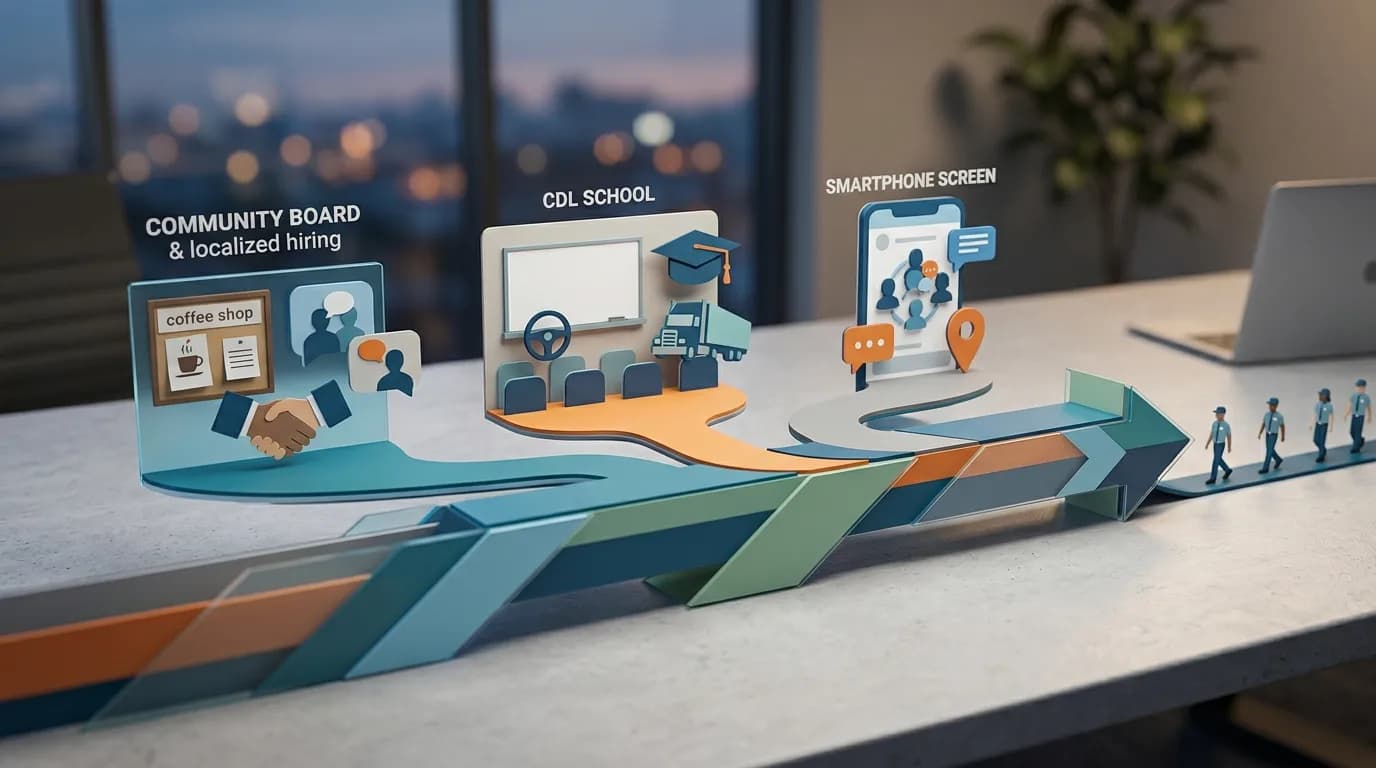
Channel 1: CDL schools and partnerships
Most FedEx Ground routes don't require a CDL — P1000/P1200 step vans fall under 26,001 lbs GVWR — but CDL schools are still your best non-Indeed channel. Here's why: people enrolled in CDL school are already self-selecting for "I want to drive for a living." They're being trained on hours-of-service compliance, DVIRs, and pre-trip inspections. By the time they finish school, they have a job-readiness most general applicants don't.
What to do:
- Identify the 2-3 CDL training schools within 30 miles of your domicile station.
- Email or visit the placement office. Most schools have a placement coordinator whose job is finding employers for graduates.
- Offer to do a 30-minute presentation to a graduating class. Bring a step van. Bring pay stubs (redacted) showing real earnings.
- Build a referral relationship — the school sends you graduates who don't want OTR work, you send the school students you want to upgrade to CDL routes later.
What it costs: time. Maybe $200 in printed materials and lunch for the placement coordinator. No paid ads.
What it yields: 1-3 hires per quarter from a school you've built a relationship with. The hires stick longer than Indeed hires, because they came in with a more accurate picture of the work.
Channel 2: Referral bounty structures that actually move drivers
Every CSP runs a referral program. Most of them don't work. Here's the difference between the ones that do and the ones that don't.
What doesn't work: a flat $500 referral bonus paid in one lump sum after 90 days. The referring driver forgets about it. The referred driver gets paid the same as everyone else. Nobody talks about it.
What works: a tiered, staged structure paid in three checkpoints, with both the referrer and the referred getting paid at each.
| Milestone | Referrer | Referred |
|---|---|---|
| New driver completes orientation + first solo week | $150 | $150 |
| 60 days, no preventable incidents, attendance ≥ 95% | $250 | $250 |
| 6 months retention | $500 | $500 |
Why this works:
- The referrer sees money fast. $150 in pocket the second week makes the program real.
- The referred driver sees a sign-on bonus structured as a retention incentive, not a recruiting gimmick.
- The 6-month payout aligns the referrer with retention, not just hiring. They actually nudge their referral when they're thinking about quitting.
Total cost per successful 6-month hire: $1,800. That sounds like a lot until you compare it to the cost of running open routes, paying overtime to cover, and re-onboarding a replacement.
Channel 3: Facebook groups that convert (and which ones to skip)
Facebook is alive and well for delivery driver hiring — but it's the groups, not the marketplace job posts, that move the needle.
The groups that work:
- Local "[Your City] Jobs" groups. Public, large membership, moderated. Post the job once a week — same listing, same hours, same pay range. Repetition matters because membership turns over constantly.
- "FedEx Ground / Home Delivery driver" groups. Drivers who already know the work. They self-identify by joining. A post here converts at 5-10x the rate of a general jobs group.
- Local immigrant / community-language groups. Many metros have large Spanish-, Portuguese-, Russian-, or Tagalog-language groups for working professionals. Bilingual posts here reach an applicant pool that doesn't see Indeed. If you can write the post in their language, do.
The groups that don't work:
- Anything with "side hustle" or "make money fast" in the name.
- Groups where every other post is an MLM pitch.
- Closed/private groups where the admin charges to let you post.
Cadence: post once a week per group. Same job, slightly varied phrasing. Engage with comments — speed of response is the single biggest predictor of whether the lead converts.
Channel 4: ZipRecruiter vs. Indeed vs. local job boards
The board comparison most owners get wrong:
| Board | Cost per applicant (2026) | Quality | Best use |
|---|---|---|---|
| Indeed Sponsored | $20-40 | Mixed | Volume; metro markets |
| ZipRecruiter | $15-30 | Slightly better, lower volume | Secondary markets |
| Craigslist | $5-10 | Highly variable | Some metros only; nearly dead in others |
| Local AM radio job line | $50-150 flat | Older applicant pool | Specific rural / mid-size metros |
| Snagajob / Hourly | $10-25 | Younger applicant pool | Entry-level supplemental |
The play: rotate. Run Indeed for two weeks, ZipRecruiter for two weeks, Snagajob for two weeks. Track which produced your last 5 hires, not your last 50 applicants. Boards that produce applicants but not hires are spending your money on a vanity metric.
Channel 5: The truck-stop flyer playbook
Underrated and free. Pilot, Flying J, Love's, and TA truck stops have community boards near the drivers' lounge. The drivers reading those boards are people who already live in the world of route driving, even if they're currently OTR and burned out on it.
What to put on the flyer:
- Headline: "Home Every Night. Local FedEx Ground Routes."
- Pay range — actual range, not "competitive pay"
- Schedule (e.g., "Monday-Friday, Saturdays optional with bonus")
- A QR code to a one-page mobile application — not a generic Indeed apply link
- Your name and direct cell number — yes, your cell. Drivers don't trust 800 numbers.
What it costs: a $40 trip to Office Depot for color flyers and a clipboard. One afternoon driving to the four nearest truck stops.
What it yields: 1-2 hires a quarter from a channel zero of your competitors are working. The OTR-to-local transition is one of the highest-quality applicant types you can recruit — they're already DOT-compliant, used to the lifestyle, and ready to go home at night.
Channel 6: Second-chance hiring (with compliance guardrails)
This is the channel most owners write off without doing the math. Roughly 1 in 3 Americans has a criminal record. If you reflexively disqualify anyone with a background, you're disqualifying 33% of your pipeline — including a lot of high-retention, hardworking adults who are looking for an employer willing to give them a chance.
The compliance guardrails:
- Disqualifying offenses are narrower than you think. FedEx Ground's contractor agreement requires you to follow applicable background standards, but it does not require you to exclude any record. Violent crimes, sex offenses, and certain felonies within recent windows are disqualifiers. Non-violent property crimes from 8 years ago generally are not.
- Use the EEOC's individualized assessment framework. The nature of the offense, time elapsed, and relationship to the job duties. Document the assessment.
- MVR is the harder filter. A clean criminal record with three at-fault crashes in 3 years is more disqualifying than a 10-year-old non-violent felony with a clean MVR since. Drive history matters more for this work than legal history.
- Partner with a workforce development nonprofit. Most metros have one. They pre-screen candidates, often provide a retention coach for the first 90 days, and sometimes offer a tax credit (WOTC) at the federal level — up to $2,400 per qualifying hire.
What it yields: consistently higher retention than open-market hires, in part because the driver knows the opportunity is rare. Owners running this channel report 18-24 month average tenure vs. 8-12 for general hires.
Building a steady pipeline instead of panic-hiring
The single biggest mistake CSPs make is hiring reactively — three drivers quit in October, peak hits in November, you panic-hire whoever shows up. Those panic hires drive your retention numbers, your accident rate, and your RYDE score into the floor for the next 6 months.
The fix is a posted plan, not a feeling.
A pipeline plan looks like this:
- Target headcount: desired drivers + 10% buffer.
- Sourcing rhythm: at least 5 active channels at all times. Never put all your spend on one.
- Application-to-hire conversion target: 5-8% for general boards, 15-25% for referrals and CDL schools.
- Time-to-fill target: 14 days from open to start.
- Weekly recruiting time: 4 hours blocked on the owner or operations manager's calendar.
If you do this consistently for 6 months, you stop panicking. You'll have a bench. You'll be able to fire the marginal driver because you know the next one is already in interview.
The CSPs who never seem to be short drivers are not lucky. They're spending 4 hours a week on recruiting in March so they don't spend 30 hours a week on it in November.
Where pay structure comes back into this
Recruiting brings drivers in. Pay keeps them. The channels above will burn out fast if your pay package is dollar-flat per stop with no recognition for the work that drives your RYDE and PPOD scores. The drivers your customers love — the ones who show up in compliment verbatims — quit for $1 more elsewhere if you've given them no reason to stay.
We covered the mechanics of tying RYDE and PPOD performance into per-stop pay in How to Tie RYDE & PPOD Scores Into Driver Bonus Pay. The short version: a $25-75 weekly bonus tied to CX metrics costs less than replacing one driver every quarter, and it changes who refers their friends.
The bottom line
There is no single channel that solves the driver shortage. There is a 5-channel pipeline that does. CDL schools, real referral programs, the right Facebook groups, rotating job boards, truck-stop flyers, and second-chance partnerships — each contributing 1-3 hires a quarter — adds up to a steady supply most CSPs would consider magical.
Pick the channel from this list that you have not used in the last 6 months. Spend two hours on it this week. Repeat that one decision for six weeks and you will have meaningfully changed your hiring outlook before peak season starts again.
See FleetWage in Action
Tell us where to reach you and we'll set up a 20-minute live demo tailored to your CSA count — no slide decks, just the product.
No spam. We'll only use this to schedule your demo.