
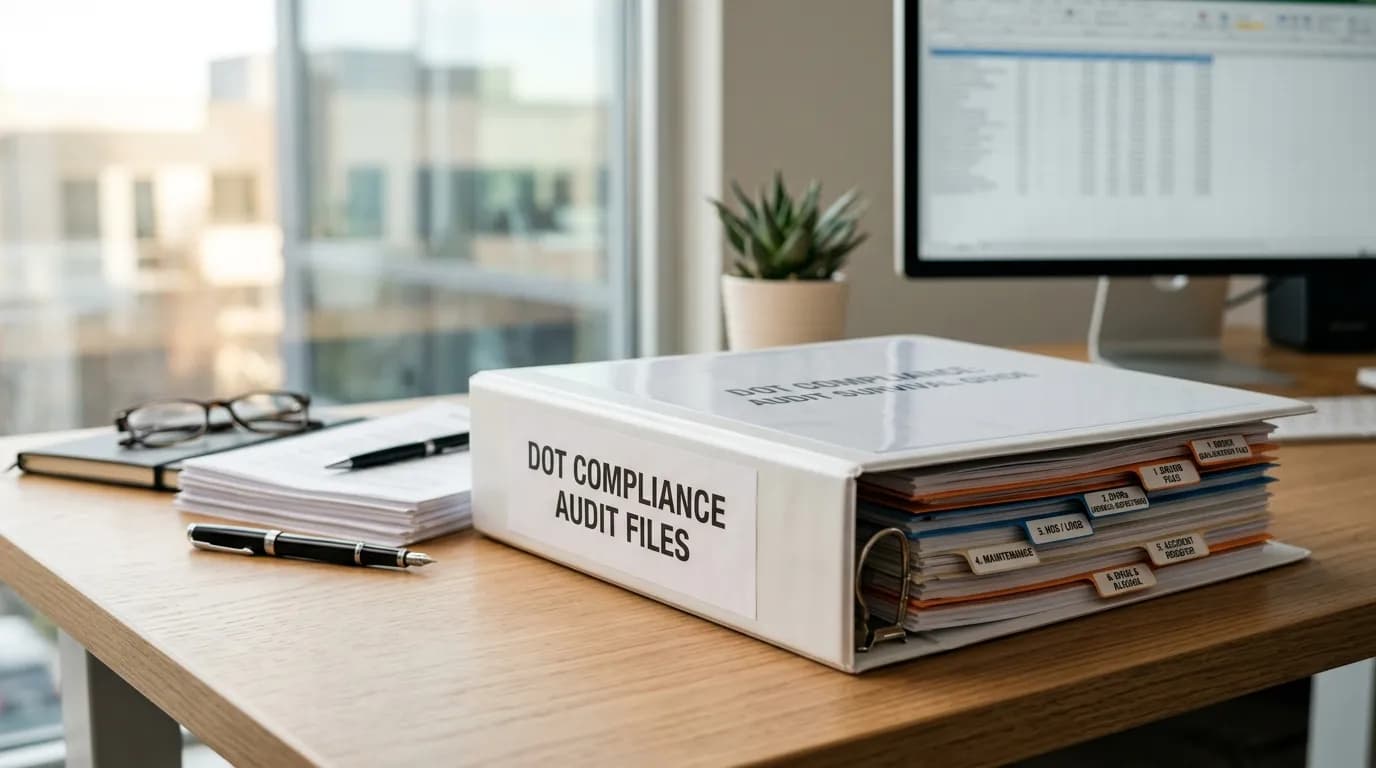
Most FedEx ISPs don't think about DOT audits until the letter shows up. By the time it does, you have roughly two weeks to assemble files you should have been maintaining for years — and you're frantically googling what a "driver qualification file" actually contains while your business credit rating hangs on the answer.
This guide is the opposite of that scramble. It walks through what triggers an audit, the three audit types you might face, the year-round binder that lets you say "yes" instead of "give me a minute" when the auditor asks for a document, the common findings that wreck otherwise-good operators, and what your final rating actually means for your FedEx Ground operating agreement.
It is written for the owner who hires, dispatches, and pays drivers — not for a compliance consultant who'll bill you $4,000 to tell you what you'll read below.
What actually triggers a DOT audit
The Federal Motor Carrier Safety Administration (FMCSA) doesn't pick contractors at random. There are five common triggers, and most FedEx ISPs walk into one of them without realizing it.
- New entrant status. Every new motor carrier with a USDOT number gets a new-entrant safety audit within the first 12 months. If you stood up a new entity to take on a route, that clock has started.
- Crash involvement. A serious crash — especially one with injury, fatality, or hazmat — triggers a compliance review with high probability.
- Roadside inspection patterns. Repeated out-of-service violations show up in the SMS (Safety Measurement System) BASIC categories and bump you toward the top of the audit queue.
- Complaints filed with the FMCSA. A driver, a customer, or even a competitor can file a complaint. The agency follows up.
- Random / scheduled review. Carriers with a "Conditional" safety rating get re-reviewed on a defined cadence.
The CSA scores in the SMS portal are public. Check yours at ai.fmcsa.dot.gov (opens in new tab) once a quarter. If two or more BASICs are over the intervention threshold, an audit isn't a question of "if" — it's a question of "when."
The three audit types you might face
These are not interchangeable, and confusing them is the first mistake panicked owners make.
| Audit type | Trigger | Scope | Outcome |
|---|---|---|---|
| New Entrant Safety Audit | First 12 months as a new carrier | Educational; basic safety management controls | Pass / Fail (not a rating) |
| Compliance Review (CR) | Crash, complaint, SMS score, follow-up | Deep — full records audit | Safety rating: Satisfactory / Conditional / Unsatisfactory |
| Focused Review | Specific BASIC area | Narrow — only the flagged category | Updated rating |
New entrant audits are the friendliest. The auditor's job is to confirm you understand the regulations and have basic systems in place. Fail one, and you have 60 days to fix the issues before your operating authority is revoked.
Compliance reviews are the ones that take businesses out. A Conditional rating restricts certain operations and triggers a follow-up audit. An Unsatisfactory rating after 45-60 days means you cannot operate. FedEx Ground will not sign or renew an operating agreement with an Unsatisfactory carrier.
Focused reviews zero in on the BASIC where you've been flagged — Hours of Service compliance, Vehicle Maintenance, Driver Fitness, etc. Narrower scope, but the documents the auditor wants are not narrower.
The year-round binder: what auditors actually request
This is the section worth printing. If you keep these six file groups current, week to week, an audit goes from existential threat to inconvenience.
1. Driver Qualification Files (DQF)
Required by 49 CFR §391.51 (opens in new tab). One file per driver, maintained for the duration of employment plus 3 years after termination.
Each file must contain:
- Driver's application for employment — 49 CFR §391.21 (opens in new tab)
- Inquiry to previous employers, 3 years back — 49 CFR §391.23 (opens in new tab)
- Motor Vehicle Record (MVR) inquiry, initial and annual — 49 CFR §391.25 (opens in new tab)
- Annual review of driving record by the carrier — signed
- Medical examiner's certificate (DOT physical card) — current
- Road test certificate or equivalent CDL — 49 CFR §391.31 (opens in new tab), §391.33 (opens in new tab)
- Drug & alcohol pre-employment test result
- Previous employer drug/alcohol history inquiry — 49 CFR §40.25 (opens in new tab)
- Annual driver's certification of violations — 49 CFR §391.27 (opens in new tab)
The single most common DQF finding: missing or expired medical certificate. Set a 60-day-before-expiration calendar alert for every driver. Don't rely on the driver to remind you.
2. Driver Vehicle Inspection Reports (DVIRs)
Required by 49 CFR §396.11 (opens in new tab). Every driver must complete a DVIR at the end of each tour of duty for each vehicle operated. Reports noting defects must be reviewed and signed by the maintenance person; reports with no defects must still be retained.
Retention: 90 days minimum. Most owners keep 12 months for safety.
Common gap: drivers checking "no defects" on every DVIR for months when the vehicle has documented work orders for the same period. That contradiction is the kind of thing an auditor finds in 90 seconds.
3. Hours of Service (HOS) Records
The ELD mandate (49 CFR §395.8 (opens in new tab)) means most of this is electronic — but the paper trail still matters.
Required records:
- 6 months of ELD data per driver
- Supporting documents: bills of lading, fuel receipts, payroll records, dispatch records, GPS data
- Driver edits to ELD records — and your approval of them
- ELD malfunction records and the paper logs used during malfunctions
The gap auditors look for: drivers who consistently log "off duty" at the station before they've actually left for the day, or "on duty not driving" stretches that don't match the dispatch record. Pull a random week, compare ELD records to settlement data, and see if the story matches.
4. Drug & Alcohol Program Records
Required by 49 CFR Part 382 (opens in new tab) and Part 40 (opens in new tab). We covered this in depth in The Owner's Guide to DOT Drug & Alcohol Testing for FedEx Contractors.
Required for the audit:
- Written drug & alcohol policy — and signed driver acknowledgements
- Pre-employment test results (1 year minimum, 5 for positives)
- Random testing selection records — proof of the 50% drug / 10% alcohol annual rate
- Reasonable-suspicion supervisor training documentation (60 + 60 minutes)
- Clearinghouse query receipts — pre-employment and annual
- Return-to-Duty / SAP records for any prior violations
The killer finding: no Clearinghouse queries on file. The FMCSA Drug & Alcohol Clearinghouse has been mandatory since 2020. If you haven't queried it on every driver at hire and annually, the auditor knows immediately.
5. Vehicle Maintenance Files
Required by 49 CFR §396.3 (opens in new tab). One file per vehicle, retained while the vehicle is in your fleet plus 18 months.
Each file must contain:
- Vehicle identification (VIN, make, model, year, tire size)
- Schedule of inspection, repair, and maintenance
- Records of every inspection, repair, and maintenance performed
- Annual inspection records — 49 CFR §396.17 (opens in new tab), §396.21 (opens in new tab) — and the qualifications of the person who did them
Common gap: the annual inspection sticker is on the truck, but the underlying inspection report and inspector qualification document aren't in the file. The sticker is not the record. The report is.
6. Accident Register
Required by 49 CFR §390.15 (opens in new tab). Every recordable accident, retained for 3 years.
Each entry needs:
- Date, location, driver name
- Number of injuries / fatalities
- Whether hazmat was released
- Copy of any state-required accident report
A "recordable accident" is one involving a fatality, an injury requiring transport for medical treatment, or a vehicle requiring tow-away. Fender benders in the yard usually don't qualify. When in doubt, log it.
How the auditor actually walks through it
A compliance review typically runs 1-3 days, depending on fleet size. The pattern:
Day 1 — opening conference. The auditor explains scope, asks for an organizational overview, and requests the master document set: USDOT number, MC authority, insurance certificates, list of all drivers, list of all vehicles, accident register. You don't want to spend day 1 looking for these.
Day 1-2 — sample selection. The auditor pulls a random sample of drivers and a random sample of vehicles. For each sampled driver, they request the full DQF, drug/alcohol records, MVR history, and 6 months of HOS data. For each sampled vehicle, they request maintenance files and DVIRs for the same period.
Day 2-3 — deep review. This is where findings emerge. The auditor cross-references: does the dispatch record show this driver driving when the ELD shows them off duty? Did the driver have a current medical card on the date they were dispatched on June 14? Is the annual inspection report in the file for VIN X?
Closing conference. The auditor walks you through preliminary findings and gives you a chance to respond. Final findings come in writing 30-60 days later.
The auditor is not your enemy. They are following a checklist. Hand them the document fast, in the right format, and the audit ends faster. Make them search, and they'll find things you didn't know existed.
The seven findings that hit FedEx ISPs most often
After reviewing audit results across dozens of contractors, the same gaps recur:
- Expired or missing medical certificates. Single highest-frequency finding.
- No FMCSA Clearinghouse query on a driver. Auto-finding; no judgment involved.
- DVIRs with "no defects" while maintenance records show open repair orders.
- Random drug testing rate below 50% annually. The rate is calculated against the average number of driver positions, not your roster on Dec. 31.
- No annual MVR review documented. You ordered the MVR, but you never signed the review.
- Annual vehicle inspection report missing from the vehicle file — even though the sticker is on the truck.
- No reasonable-suspicion supervisor training documentation. The training happened informally, but there's no certificate, no date, no signature.
Five of the seven are paperwork problems, not safety problems. That's the unfair part of compliance: the auditor isn't measuring whether you run a safe operation. They're measuring whether you can prove it.
What your safety rating actually means
After a compliance review, the FMCSA issues one of three ratings.
- Satisfactory. No restrictions. Renewal-friendly for FedEx Ground.
- Conditional. You can continue operating, but you're flagged for follow-up. FedEx Ground may pause expansion conversations and may require you to demonstrate corrective action.
- Unsatisfactory. You have 45-60 days to address findings before your operating authority is revoked. FedEx Ground operating agreements typically include termination language for an Unsatisfactory rating.
You can request an upgrade after demonstrating corrective action under 49 CFR §385.17 (opens in new tab). Get this in motion the same week the finding letter arrives, not 30 days later.
A 90-day audit-readiness sprint
If you've never been audited and the binder above sounds aspirational, this is the catch-up plan.
Week 1-2: Pull every driver's medical card. List the expiration dates. Set 60-day-before alerts. Refresh anything expiring within 90 days.
Week 3-4: Pull every driver's Clearinghouse query history. Run any missing pre-employment or annual queries. Document each one.
Week 5-6: Reconcile DVIRs against maintenance work orders for the last 90 days. Identify and explain any contradictions in a memo to file.
Week 7-8: Pull the annual inspection report and inspector qualifications for every vehicle. Refile anything missing.
Week 9-10: Validate your random drug testing selection meets the 50% / 10% annual rate. If you're short, schedule a make-up draw with your TPA.
Week 11-12: Sit down with your DQF binder. Spot-check 3 random drivers as if you were the auditor. Anything you can't find in 60 seconds, fix.
You won't be audit-proof at day 90. You will be in a position to survive an audit with a Satisfactory rating instead of a Conditional one.
Where FleetWage fits
The reason owners dread audits isn't that they're running unsafe operations. It's that the records are scattered: medical cards in a filing cabinet, DVIRs in a glovebox, drug test results in an email, maintenance work orders in a separate shop system, driver applications in a folder on someone's laptop.
FleetWage maintains the driver-side of that binder as a byproduct of payroll: every driver's qualification record, medical card expiration, Clearinghouse query, drug test history, and signed acknowledgements live in one place, tied to the same driver ID that runs payroll. When an auditor asks for "the full DQF and drug/alcohol record for these five drivers," you export it instead of assembling it.
Maintenance files still live with your shop. But the records the FMCSA pulls from drivers — the ones that take the longest to find under pressure — stop being a 2 AM problem the week the audit letter shows up.
The bottom line
A DOT audit is not a one-time exam. It's an audit of habits you either kept or didn't, going back years. The binder doesn't get built in two weeks. It gets built in the 18 months before the letter shows up — through small, repeated, boring tasks that look like wasted time until they aren't.
The owners who pass with Satisfactory ratings are not smarter or better connected. They picked one of the six file groups above each week and made sure it was current. That's the whole secret.
See FleetWage in Action
Tell us where to reach you and we'll set up a 20-minute live demo tailored to your CSA count — no slide decks, just the product.
No spam. We'll only use this to schedule your demo.